Delimitation Bill 2026 What It Means for India’s Political Future
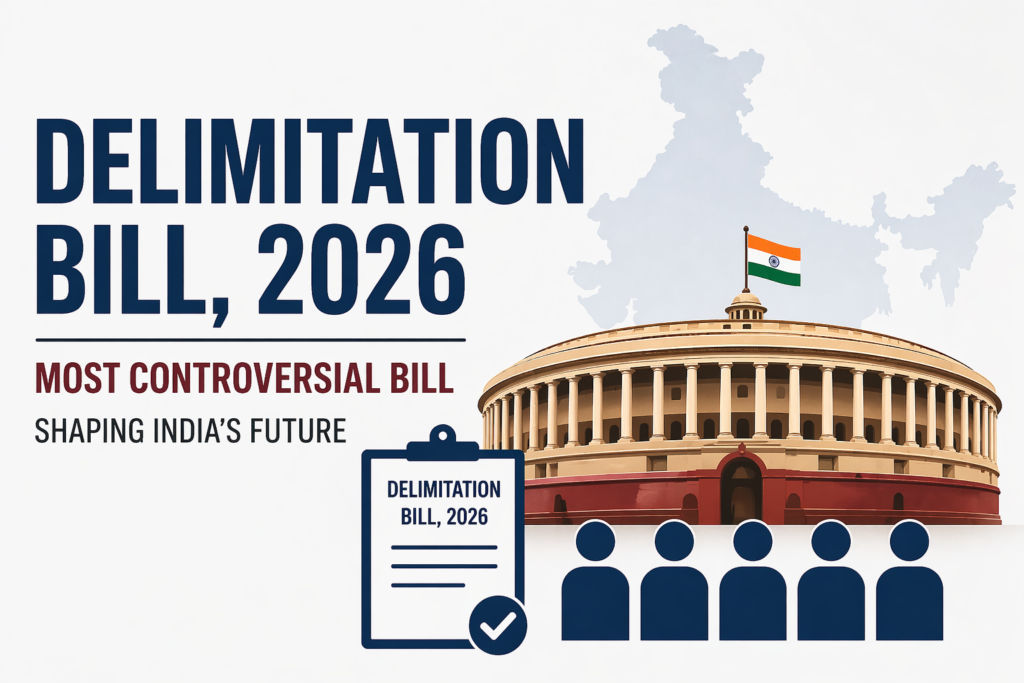
Introduction India is approaching an important turning point in its democratic structure. The proposed Delimitation Bill 2026 has started gaining attention among legal experts, policymakers, and the general public. While the term may sound technical, its impact is simple and direct. It decides how people are represented in Parliament and State Assemblies. In a country with vast population differences across regions, ensuring fair representation is not easy. This is why the upcoming delimitation exercise is expected to be one of the most significant political developments in recent years. What is Delimitation Delimitation is the process of redrawing the boundaries of electoral constituencies based on changes in population. The purpose is to ensure that each elected representative speaks for roughly the same number of people. In India, this process is carried out by a Delimitation Commission. It is an independent body, and its decisions cannot be challenged in court. This ensures neutrality and prevents political interference. Why Delimitation is Scheduled for 2026 The need for delimitation in 2026 comes from earlier constitutional decisions. In 1976, the government froze the allocation of seats in Parliament and State Assemblies. This was done to encourage states to control population growth without fearing loss of representation. Later, this freeze was extended until 2026. As a result, even though India’s population has changed significantly, the number of seats and their distribution have remained largely the same. Once this freeze ends, a fresh delimitation exercise becomes necessary to reflect current population realities. Key Features of the Delimitation Bill 2026 Although the final version of the bill is yet to be officially presented, several expected features are being discussed. First, there may be a redistribution of seats in the Lok Sabha. States with higher population growth could receive more seats. Second, constituency boundaries will be redrawn to ensure that each constituency has a similar population size. Third, there is a possibility that the total number of Lok Sabha seats may be increased to better represent India’s growing population. Fourth, reserved seats for Scheduled Castes and Scheduled Tribes may be adjusted according to updated data. The North and South Debate One of the most sensitive aspects of the 2026 delimitation is its regional impact. Northern states such as Uttar Pradesh and Bihar have experienced higher population growth. On the other hand, southern states such as Tamil Nadu and Kerala have successfully controlled their population. If representation is adjusted purely on the basis of population, northern states are likely to gain more seats. This could lead to southern states having relatively less influence in Parliament. This situation raises an important question. Should political representation depend only on population, or should governance and population control efforts also be considered Legal and Constitutional Questions The Delimitation Bill 2026 is likely to raise several legal debates. One issue is the balance between states in a federal structure. Any major shift in representation can affect how power is distributed. Another concern is whether such changes could be tested under the basic structure doctrine of the Constitution. If representation is altered drastically, it may invite judicial scrutiny. There is also a broader debate between equality and fairness. While equal representation is important, it must not lead to unintended disadvantages for certain regions. Political Impact The political consequences of delimitation will be significant. States gaining more seats will have greater influence in national decision making. This can change the overall balance of power in Parliament. Political parties will need to rethink their strategies as constituency boundaries change. Regional parties may either gain or lose importance depending on how the new constituencies are shaped. Possible Solutions To address concerns, several approaches can be considered. One option is to increase the total number of seats in the Lok Sabha so that no state loses its current representation. Another approach is to implement changes gradually instead of all at once. This can reduce political tension. There can also be discussions on creating a balanced model that considers both population and other factors such as development. Why It Matters Delimitation directly affects every citizen. It determines who represents you and how much weight your vote carries. In simple terms, it shapes the functioning of democracy. A fair delimitation process ensures that every vote has equal value. Conclusion The Delimitation Bill 2026 is more than just a technical reform. It is a major step that will shape the future of India’s democracy. It brings together questions of law, fairness, representation, and regional balance. The real challenge lies in carrying out this process in a way that is just, transparent, and acceptable to all parts of the country. The decisions made now will have long term effects on how India is governed and how its people are represented.
India’s Rape Problem – Why do Rapist’s Rape – Why India is also called Rape Capital – How many are Fake Rape Cases

Introduction Sexual violence is one of the most disturbing issues facing modern societies, and India is no exception. Over the years, incidents of rape and sexual assault have sparked nationwide outrage, legal reforms, and intense debate. At the same time, India is often labeled—sometimes unfairly – as the “rape capital” of the world. But what is the truth behind these claims?Why do such crimes occur?And how significant is the issue of false rape cases? This article aims to present a balanced, fact-based, and legally informed perspective on these questions. Understanding the Legal Definition of Rape in India Under Section 375 of the Indian Penal Code (IPC), rape is broadly defined as sexual intercourse without consent, obtained through coercion, fear, deception, or when the victim is incapable of giving consent. The law has evolved significantly, especially after the 2012 Delhi gang rape case, leading to stricter punishments and broader definitions under the Criminal Law (Amendment) Act, 2013. Why Do Rapists Commit Rape? (Root Causes) There is no single reason behind sexual violence. It is a complex issue influenced by multiple factors: 1. Power and Control, Not Just Sexual Desire Rape is often about asserting dominance rather than sexual gratification. Many offenders seek control over the victim. 2. Patriarchal Mindset Deep-rooted gender inequality and societal norms that treat women as subordinate contribute significantly. 3. Lack of Sex Education Inadequate understanding of consent and healthy relationships leads to distorted perceptions about sexuality. 4. Cultural Silence and Victim-Blaming Victims are often blamed or shamed, which discourages reporting and indirectly empowers offenders. 5. Weak Enforcement and Delayed Justice Although laws are strict, delays in investigation and trial reduce deterrence. 6. Exposure to Violence and Toxic Influences Media, pornography (when misunderstood), and exposure to violence without proper guidance can influence behavior in some cases. Is India Really the “Rape Capital of the World”? The term “rape capital” is widely used in media, but it is misleading and lacks context. Reality Check: Why Does India Get This Label? 👉 Conclusion:India does have a serious problem with sexual violence, but the label “rape capital” is oversimplified and not statistically accurate. How Many Rape Cases Are False? (The Controversial Debate) This is one of the most misunderstood aspects. What Do Official Data Say? Important Clarifications: Cases may be labeled “false” due to: Actual Malicious False Cases 👉 Balanced View: Challenges in Addressing Rape in India 1. Underreporting Many victims still do not report due to fear, stigma, or lack of trust in the system. 2. Police and Investigation Issues Insensitive handling and procedural delays discourage victims. 3. Judicial Delays Cases can take years, reducing faith in justice. 4. Social Stigma Victims often face more scrutiny than perpetrators. What Needs to Change? 1. Stronger Implementation of Laws India has strict laws, but enforcement must improve. 2. Fast-Track Courts Speedy trials can increase deterrence. 3. Gender Sensitization Education on consent and respect must start early. 4. Police Reforms Better training and victim-friendly procedures. 5. Responsible Media Reporting Avoid sensationalism and respect privacy. 6. Balanced Legal Approach Protect victims while ensuring safeguards against misuse. Conclusion India’s rape problem is real, serious, and complex – but it cannot be reduced to simplistic labels or one-sided narratives. A meaningful solution lies in legal reform, social change, and collective responsibility. Only by addressing the issue holistically can society move toward safety, justice, and dignity for all.
Supreme Court Declares Maternity Leave a Constitutional Right — Even for a Third Child
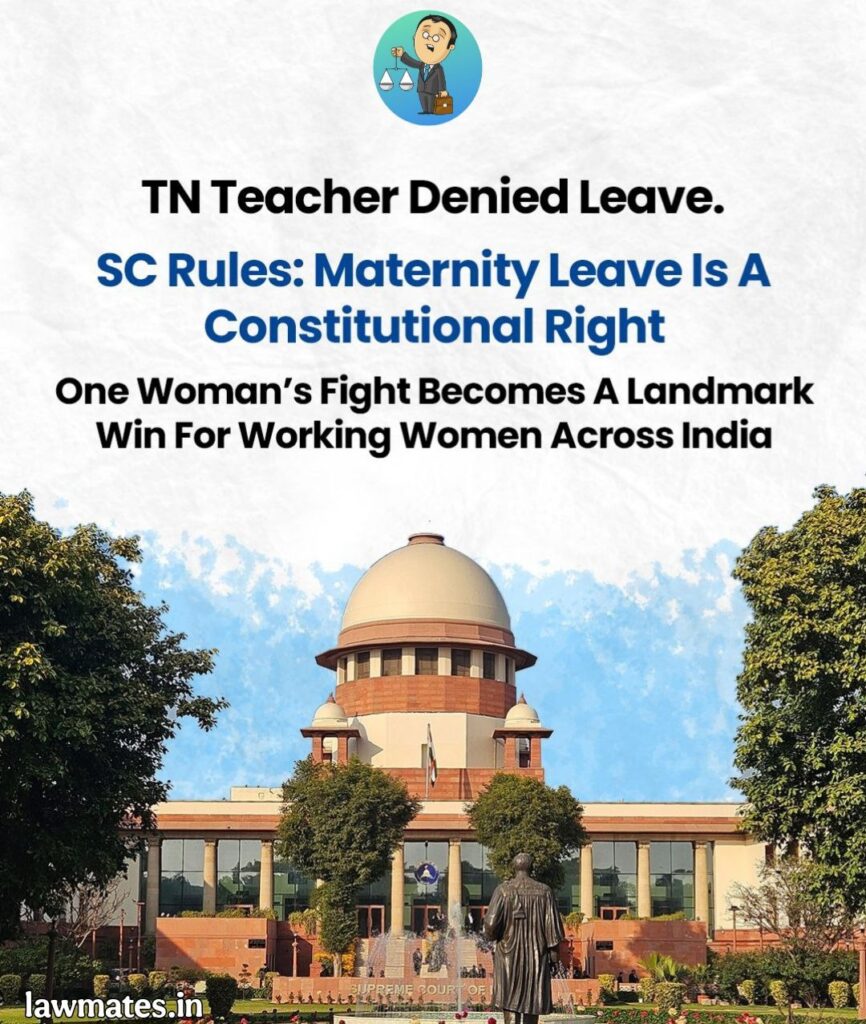
For years, maternity leave in India has mostly been talked about in the context of company policies or HR manuals. But a recent Supreme Court decision forces us to rethink how we view it, not just as a workplace benefit, but as a fundamental reproductive right for women. The Reality Women Face Women’s health is often side-lined, whether it’s inadequate research, biased treatment, or lack of support at work during and after pregnancy. Maternity leave, though a legal right, is still seen in many offices as a favour instead of a necessity. Though laws like the Maternity Benefit Act exist, many working women still struggle to access what they’re legally entitled to. A recent Supreme Court ruling highlights these gaps and reinforces that state-level rules cannot override a woman’s fundamental rights. The Case That Changed It All K. Umadevi v. Government of Tamil Nadu Umadevi, a government school teacher in Tamil Nadu, was denied maternity leave for her third child. The state cited a rule that limited maternity benefits to only two surviving children (under Rule 101(a) of the Tamil Nadu Service Rules). Initially, the Madras High Court supported Umadevi, stating that the state’s policy clashed with the Maternity Benefit Act, 1961, a central law. But a division bench later overturned that decision, arguing the central law didn’t apply to state employees. The matter went to the Supreme Court, which ruled in Umadevi’s favour. The Court firmly stated that maternity leave is an essential part of a woman’s reproductive rights, protected under human rights and constitutional principles. This verdict marks a significant step forward, especially for women employed in government roles. Understanding India’s Maternity Leave Law The Maternity Benefit Act, 1961 (amended in 2017) provides the framework for maternity leave in India: • 26 weeks of paid leave for the first and second child • 12 weeks for the third child onwards • 8 weeks can be taken before delivery • 6 weeks post-miscarriage or medical termination • 12 weeks for mothers adopting a child under 3 months However, the law excludes self-employed women and those working in companies with fewer than 10 employees. Why Maternity Leave Is More Than Just Time Off Maternity leave isn’t just about rest, it’s about retaining women in the workforce, ensuring they don’t have to choose between their career and motherhood. Good maternity policies: • Reduce dropouts from the workforce • Promote gender equity at work • Support smoother transitions back to work with flexible hours and childcare access • Guarantee job security – employers cannot fire women while on maternity leave But many women don’t claim their rights due to fear of job loss, lack of awareness, or confusion about eligibility due to conflicting state rules. What Needs to Change Maternity leave should not be treated as optional or negotiable. It’s a legal right, not a privilege. Here’s what must happen: • Raise awareness so women know their rights • Hold employers accountable for enforcing policies fairly • Train HR and management on legal compliance and sensitivity • Update outdated state policies that contradict central law At Lawmates, we believe that while laws matter, so does mindset. Maternity leave must be viewed as a standard workplace right, not something women have to fight for. Let’s make sure every woman feels empowered to claim what’s rightfully hers without resistance, confusion, or fear.