
Aye Finance Reports Strong Q4 FY26 Growth, Profit More Than Doubles
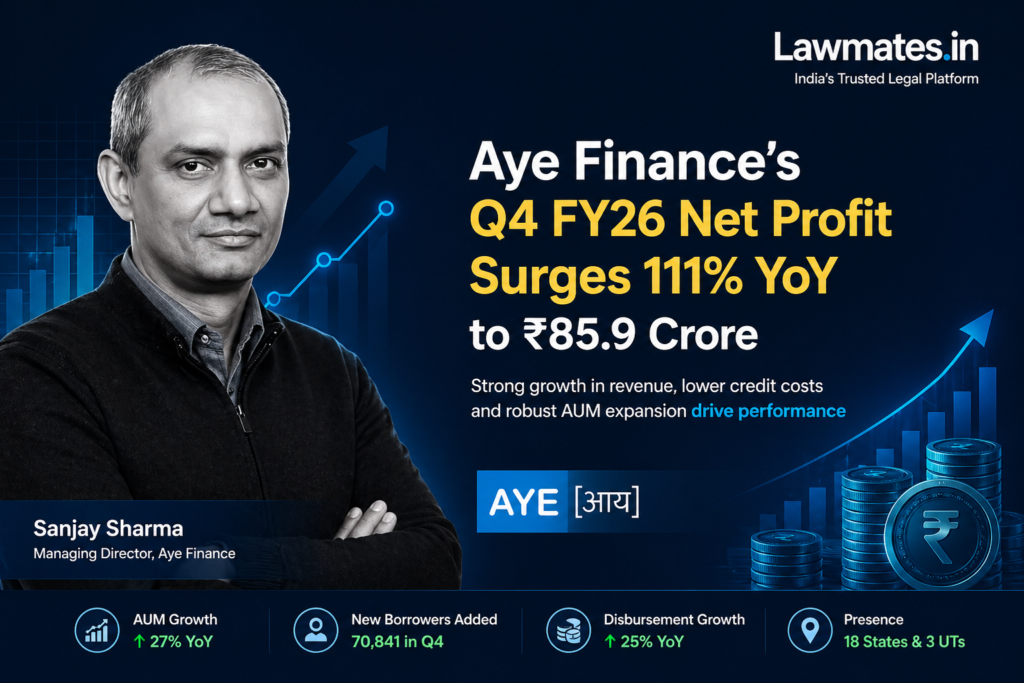
Aye Finance, one of India’s leading lenders focused on micro, small, and medium enterprises (MSMEs), delivered an impressive financial performance in the fourth quarter of FY26. The non-banking financial company (NBFC) reported a sharp rise in profitability, supported by strong loan growth, improved asset quality, and disciplined cost management. Profit Jumps Over 100% in Q4 Aye Finance posted a net profit of ₹85.9 crore in Q4 FY26, marking a remarkable 111% increase from ₹40.7 crore in the corresponding quarter last year. On a sequential basis, profit also more than doubled, rising 102% from ₹42.6 crore in Q3 FY26. This significant jump reflects the company’s ability to scale efficiently while maintaining healthy margins. It also highlights the growing demand for formal credit among underserved micro-enterprises across India. Revenue Growth Driven by Strong Core Operations Operating revenue for the quarter rose 29% year-on-year to ₹528.4 crore, compared to the same period last year. On a quarter-on-quarter basis, revenue increased 19%, underlining sustained business momentum. A major contributor to this growth was interest income, which climbed 26% year-on-year to ₹440.2 crore. This indicates robust expansion in the company’s lending portfolio and continued traction in its MSME loan offerings. Additionally, net gains from fair value changes surged sixfold to ₹48 crore, providing a substantial boost to overall earnings. The company also recorded a gain of ₹20 crore from the derecognition of financial instruments, although this was 42% lower than the corresponding quarter in the previous year. Including other income of ₹16.8 crore, Aye Finance’s total income for Q4 FY26 stood at ₹545.3 crore. Improving Asset Quality and Lower Credit Costs One of the most encouraging aspects of Aye Finance’s performance was the continued improvement in asset quality. Total expenses rose 18% year-on-year to ₹434.4 crore, a relatively moderate increase compared to revenue growth. More importantly, the company reported a 186 basis point reduction in credit costs, bringing them down to 4.3% for the quarter. This improvement follows consistent declines over the previous five quarters and reflects stronger underwriting standards, better collections, and improved borrower quality. For an MSME-focused lender, effective credit risk management is critical. Aye Finance’s ability to reduce credit costs while expanding its loan book demonstrates operational maturity and resilience. Strong Full-Year FY26 Performance For the full financial year FY26, Aye Finance reported a profit after tax (PAT) of ₹193.6 crore, up 13% from ₹171.3 crore in FY25. Operating revenue for the year grew 24% year-on-year to ₹1,814.7 crore. This consistent annual growth underscores the company’s strong market positioning in India’s expanding MSME lending segment. Loan Book and Customer Base Continue to Expand Aye Finance’s assets under management (AUM) increased 27% year-on-year to ₹7,044 crore, reflecting healthy portfolio expansion. Quarterly disbursements also rose 25% compared to the same quarter last year. During the quarter, the company added 70,841 new borrowers, further strengthening its presence in the underserved MSME credit market. This customer acquisition momentum demonstrates the vast and growing demand for accessible financing solutions among small businesses. Founded in 2014, Aye Finance specializes in providing business loans to micro-enterprises across 18 states and three union territories. Its product portfolio includes small-ticket hypothecation loans with an average ticket size of ₹1.5 lakh, as well as mortgage-backed loans averaging ₹5 lakh. Market Responds Positively Investor sentiment remained upbeat following the earnings announcement. Shares of Aye Finance surged 13.15%, trading at ₹152.45 on the BSE at 2:20 PM IST. The sharp rise in the stock price reflects market confidence in the company’s growth strategy, improving profitability, and strengthening asset quality. Outlook Aye Finance’s Q4 FY26 results highlight the strength of its business model and its deep understanding of India’s underserved MSME sector. With improving credit metrics, rising disbursements, and a growing customer base, the company appears well-positioned for sustained growth. As formal credit penetration among micro-enterprises continues to expand, Aye Finance is likely to remain a key beneficiary of this long-term structural opportunity. Its latest results reinforce its position as a significant player in India’s MSME lending ecosystem.
5 Manufacturing Startups to Watch in India in 2026
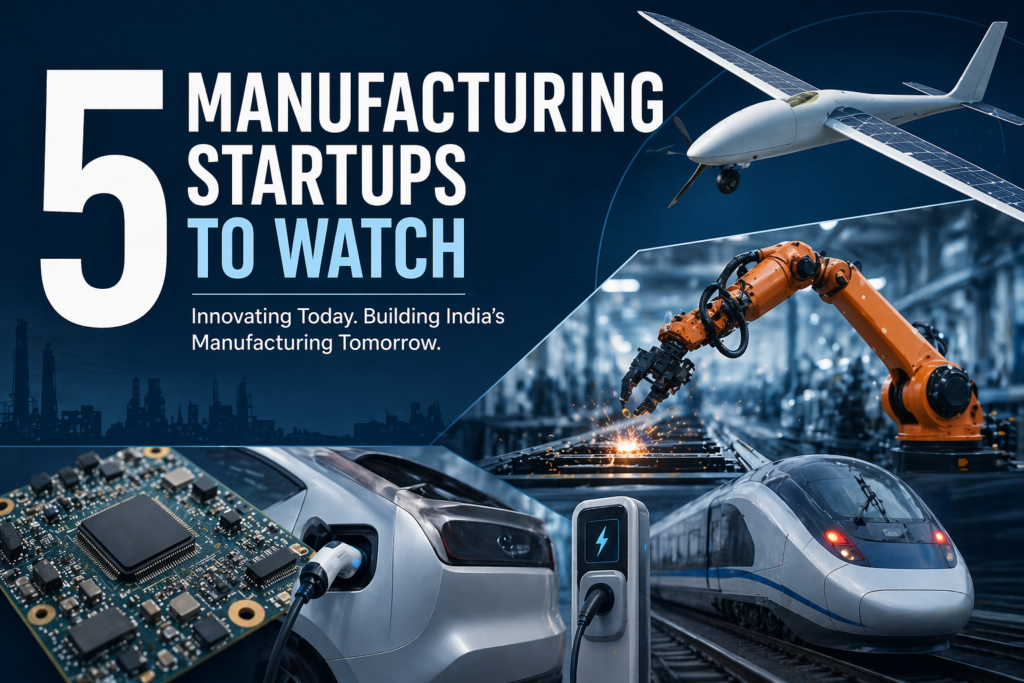
Summary India’s manufacturing momentum is accelerating, driven by robust policy support, rising investments, and large-scale infrastructure expansion. In the second edition of 5 Manufacturing Startups to Watch, we spotlight emerging innovators shaping the future of hardware, robotics, aerospace, and electronics. These startups are addressing critical industrial challenges through breakthroughs in high-performance computing, embedded systems, UAVs, and industrial automation—building the foundation for India’s next manufacturing leap. India’s manufacturing sector is entering a defining phase. Backed by strong policy support, rising capital inflows, and large-scale infrastructure expansion, the country is laying the foundation for long-term industrial growth. From electronics and semiconductors to aerospace and robotics, the momentum is unmistakable. Government initiatives continue to reinforce this shift. The expansion of the Startup India Fund of Funds to include technology-led manufacturing ventures, along with the approval of 29 projects worth over ₹7,100 crore under the Electronics Component Manufacturing Scheme (ECMS), underscores India’s commitment to industrial innovation. Adding to this momentum is the recently approved ₹33,600 crore BHAVYA scheme, which aims to develop 100 plug-and-play industrial parks across the country. Combined with continued incentives for semiconductors, electronics, and critical supply chains, these measures reflect India’s broader ambition to strengthen domestic manufacturing and move up the global value chain. That said, the journey is not without challenges. Supply chain disruptions, geopolitical tensions, rising input costs, and labour shortages continue to test manufacturers across major industrial hubs. Yet, these short-term hurdles have not slowed the sector’s long-term trajectory. Instead, they have accelerated the need for domestic innovation. A new generation of startups is stepping in to address critical gaps in hardware, embedded systems, aerospace, robotics, and semiconductor design. These companies are not merely participating in India’s manufacturing growth story; they are actively shaping it. Here are five promising manufacturing startups that are driving innovation and deserve close attention in 2026. 1. Anmaya Technologies Founded in 2022 by Nandavara Jayaram Hariprasad and Shobhitha Ujire, Anmaya Technologies is building advanced FPGA-based system-on-module solutions for aerospace, defence, and high-performance computing applications. Its customised hardware powers mission-critical systems such as satellites, drone communication networks, and secure computing platforms. As India seeks greater self-reliance in defence and space technology, Anmaya is helping reduce dependence on imported FPGA solutions. The company is also expanding into adjacent areas such as anti-drone systems and signal intelligence, positioning itself as a key player in India’s strategic technology ecosystem. 2. Bacancy Systems Established in 2021 by Binal Patel, Krunal Patel, and Hardik Sheth, Bacancy Systems develops embedded hardware and software solutions for electric mobility, healthcare, and railway infrastructure. Its product portfolio includes EV charging controllers, battery management systems, motor controllers, and embedded IoT solutions. The company is also building advanced train control and management systems to support India’s railway modernisation efforts. With end-to-end capabilities spanning design, validation, and manufacturing, Bacancy is emerging as a full-stack embedded systems provider in sectors poised for rapid growth. 3. Maraal Aerospace Founded in 2023 by Vivek Kumar Pandey and incubated at IIT Kanpur, Maraal Aerospace is redefining drone endurance through solar-powered autonomous aerial systems. Its fixed-wing UAVs are capable of operating for 12 to 16 hours, making them ideal for intelligence, surveillance, reconnaissance, maritime monitoring, and environmental tracking. The company is also developing high-altitude pseudo-satellite platforms for long-duration missions. By leveraging solar energy, Maraal addresses one of the biggest limitations of conventional drones: limited flight time. 4. Pace Robotics Founded in 2020 by Ayushmoy Roy and Srinivas K Pai, Pace Robotics is transforming the construction industry through automation. Its flagship robot, Centa Painter, autonomously performs painting, puttying, and sanding tasks on walls and ceilings. Equipped with advanced sensors, the robot can self-align, identify openings, and execute finishing work with minimal human intervention. The solution significantly improves efficiency, reduces labour dependence, and lowers costs, making it a compelling innovation for India’s rapidly growing construction sector. 5. Silizium Circuits Founded in 2020 by Arun Ashok and Rijin John, Silizium Circuits is a fabless semiconductor company focused on high-value chip design and semiconductor intellectual property. The startup develops analogue, RF, and mixed-signal semiconductor solutions for wireless communication, satellite connectivity, navigation systems, and IoT applications. Its offerings include GNSS/NavIC front-end modules, 5G RF components, and satellite communication chipsets. With applications spanning telecom, electric vehicles, drones, defence, and industrial systems, Silizium is well positioned to benefit from India’s semiconductor ambitions. The Road Ahead India’s manufacturing ecosystem is evolving rapidly. The focus is no longer limited to scale; it is increasingly centred on innovation, localisation, and technological sophistication. Startups like Anmaya Technologies, Bacancy Systems, Maraal Aerospace, Pace Robotics, and Silizium Circuits represent the next wave of industrial transformation. By addressing critical gaps in strategic sectors, they are helping build a more resilient, self-reliant, and globally competitive manufacturing economy. As India strengthens its position as a global manufacturing hub, these emerging companies are likely to play a pivotal role in defining the future of industrial innovation.
Reliance Appoints Parminder Singh to Lead AI Venture
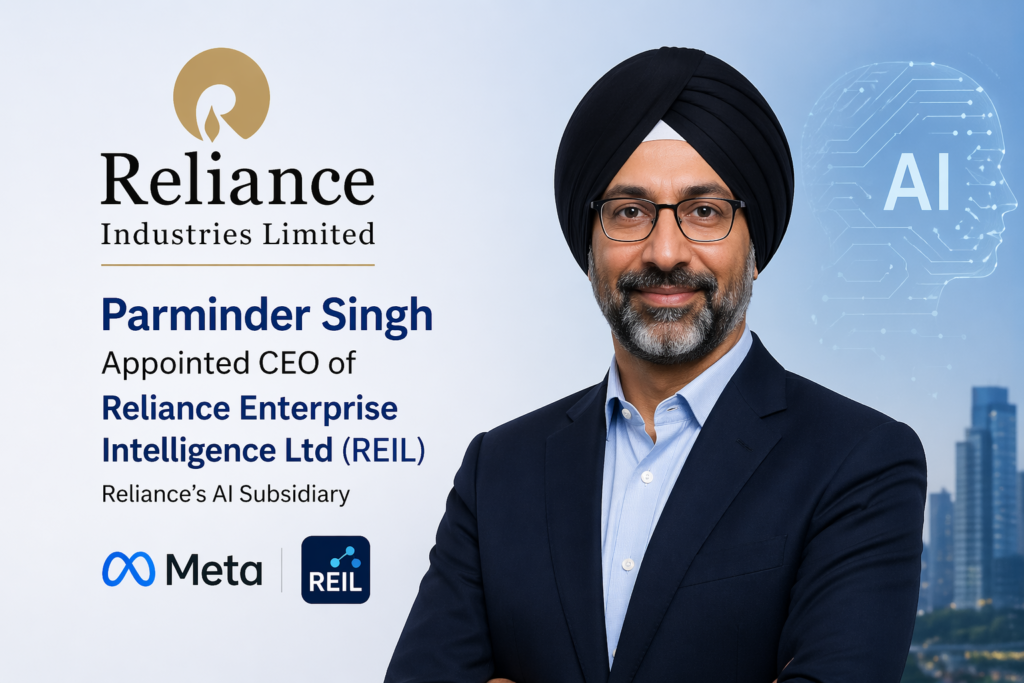
Summary Reliance Industries has appointed Parminder Singh as CEO of Reliance Enterprise Intelligence Ltd, its AI venture with Meta Platforms. With deep experience at Google, Apple, X, and IBM, Singh will lead Reliance’s enterprise AI strategy. The appointment underscores Reliance’s growing focus on artificial intelligence as India’s AI market expands rapidly, positioning the company to play a leading role in the country’s digital transformation. Reliance Industries has appointed former Google executive Parminder Singh as the Chief Executive Officer of Reliance Enterprise Intelligence Ltd (REIL), marking a significant step in the conglomerate’s ambitious push into artificial intelligence. The appointment takes immediate effect and signals Reliance’s intent to build a strong leadership foundation for its fast-growing AI business. With India rapidly emerging as a major AI market, the move places Reliance at the forefront of the country’s enterprise AI transformation. A Strategic Leadership Appointment Announcing the appointment, Akash Ambani described Singh as a leader uniquely positioned to guide Reliance’s AI ambitions. He highlighted Singh’s blend of global technology expertise, deep understanding of Asian markets, and proven executive leadership. Singh is expected to spearhead the development of a world-class team while shaping REIL’s long-term strategy. His appointment reflects Reliance’s broader vision of creating a robust AI ecosystem capable of serving enterprises across industries. In his first statement as CEO, Singh expressed confidence in the venture’s potential, particularly the strategic advantages created by the partnership between Reliance and Meta Platforms. He noted that the combined strengths of both companies offer a uniquely differentiated proposition in the enterprise AI space. Parminder Singh’s Global Technology Pedigree A graduate of Panjab University, Singh brings decades of leadership experience across some of the world’s most influential technology companies. His career spans senior roles at Google, Apple, X, and IBM. He has also held leadership positions in Asia’s media and technology sectors, including with Singapore-based Mediacorp. More recently, Singh co-founded ClayboxAI, a leadership advisory firm, and WeKamp, an AI-driven community platform. This diverse experience positions him well to lead a business operating at the intersection of technology, enterprise, and innovation. Reliance and Meta’s AI Joint Venture REIL was established following the strategic joint venture announced by Reliance and Meta in August 2025. The partnership was launched with an initial investment of approximately ₹855 crore, underscoring the scale of both companies’ commitment to enterprise AI. Under the ownership structure, Reliance holds a 70 percent stake through its investment of ₹596.6 crore, while Meta, through Facebook Overseas, owns the remaining 30 percent after investing ₹256.6 crore. The venture aims to combine Meta’s advanced AI capabilities, including its open-source Llama models, with Reliance’s vast digital infrastructure, computing capabilities, and enterprise distribution network. This synergy could position REIL as a key player in India’s rapidly expanding enterprise AI market. Why This Matters for India’s AI Ecosystem Reliance’s aggressive AI expansion aligns with India’s broader ambition to become a global leader in artificial intelligence. Earlier this year, Mukesh Ambani announced a staggering ₹10 lakh crore investment in AI and related technologies over the next seven years, beginning in 2026. This commitment reflects a larger shift among Indian conglomerates toward deep technology, particularly AI, as they seek to diversify beyond traditional sectors such as telecom, retail, and energy. The Indian government is also actively supporting this transformation. In the Union Budget 2026–27, Finance Minister Nirmala Sitharaman allocated ₹1,000 crore to the IndiaAI Mission to strengthen AI infrastructure and data centre capacity. At the same time, Indian AI innovators are making rapid progress. Companies such as Sarvam AI and initiatives like BharatGen are building large language models tailored to Indian languages and use cases, helping create a more self-reliant AI ecosystem. The Road Ahead India’s AI market is projected to exceed $126 billion by 2033, with the potential to contribute as much as $1.7 trillion to the country’s GDP by 2035. Against this backdrop, Reliance’s appointment of Parminder Singh is more than a leadership change—it is a strategic bet on the future of enterprise technology. With strong financial backing, a powerful partnership with Meta, and seasoned leadership at the helm, REIL is well positioned to shape the next phase of AI adoption in India. For Reliance, this is not merely an expansion into a new sector. It is a calculated move to become a defining force in India’s digital and technological future.
Is India Missing the AI Investment Boom?
Summary As global capital increasingly shifts toward artificial intelligence-led growth, India risks being sidelined. While companies in the country are adopting AI, most are using it to improve efficiency rather than to build new products or scalable revenue streams — a factor that is influencing investor sentiment and capital flows. The Global AI Race Is Now a Capital Race The global competition in artificial intelligence is no longer just about technological capability. It is increasingly about where capital is being deployed. At present, the United States is leading this shift decisively. Companies there are investing aggressively in: According to a report by Stanford University, private AI investment in the US reached $285.9 billion in 2025, dwarfing China’s $12.4 billion. Despite concerns about a potential AI bubble, investor enthusiasm remains strong. The message is clear: capital is chasing long-term AI-driven value creation, not just incremental innovation. India’s Position: Present, But Not Leading India is not absent from the AI story — but it is not at the forefront either. A growing concern is the shift of foreign capital away from Indian markets. Investors are increasingly reallocating funds to economies and companies that offer stronger exposure to AI-led growth. This is not because Indian companies lack AI adoption. In fact, many firms are actively integrating AI into their operations. However, the intent behind adoption differs significantly. In India, AI is largely being used to: What is missing is large-scale evidence of AI being used to: And in today’s market, that distinction matters. Capital Is Moving — And the Numbers Reflect It Recent data highlights a clear shift in global investment patterns. While macroeconomic factors like inflation, geopolitical tensions, and currency pressures play a role, they are only part of the story. At the same time: More importantly, AI continues to dominate global capital allocation. Estimates suggest that US-based companies captured nearly 79% of global AI funding in 2025. Why Investors Are Looking Elsewhere From an investor’s perspective, this shift is not surprising. Markets such as Taiwan, South Korea, and China are increasingly seen as attractive alternatives. They offer: In comparison, Indian companies are often viewed as relatively expensive without offering comparable AI-led growth narratives. The Core Issue: Efficiency vs Innovation At the heart of the issue lies a fundamental difference in how AI is being utilised. In India: AI is primarily a tool for efficiency In the US: AI is a driver of innovation and expansion This divergence has significant implications. Investors today are not asking whether companies are using AI.They are asking: Is AI creating new value? Without clear signals of: Indian firms risk being seen as efficiency stories rather than growth stories. Structural Challenges in the Indian IT Sector The gap is not just strategic — it is structural. India’s IT industry has historically been: This model, while successful in the past, may limit participation in the current AI-led value cycle. Meanwhile, many Indian IT firms have taken a cautious approach: This signals a wait-and-watch strategy, which may carry long-term risks. The Risk of Falling Behind The biggest concern is timing. In fast-evolving sectors like AI, early movers often capture a disproportionate share of value. If companies delay meaningful investments, the most lucrative opportunities may already be taken. Global investors are aware of this dynamic. As a result, many are: This is not a complete exit — but it is a pause. And in capital markets, pauses can be just as significant. What We Believe India stands at a critical juncture in the global AI landscape. The country has: But to remain competitive, it must move beyond using AI for efficiency alone. The next phase of growth will belong to companies that: Until then, global capital is likely to continue flowing toward markets that are not just adopting AI — but building the future around it.
How Bonkers Corner Didn’t Just Build a ₹195 Brand — It Outsmarted India’s D2C Playbook

Summary Bonkers Corner began in 2020 with founder Shubham Gupta doing the basics right — creating simple designs, testing them as mockups, and using Instagram ads to generate real demand before even producing inventory. What followed wasn’t aggressive expansion, but disciplined execution. The brand stayed consistent with its core playbook: focus on everyday essentials, keep the team lean, and maintain complete control by running operations in-house. Today, Bonkers has scaled that simple approach into a massive unisex streetwear portfolio of over 12,000 SKUs, spanning oversized apparel, gym wear, joggers, hoodies, and sweatshirts — proving that clarity beats complexity in building a fashion brand. The Anti-Startup Story Nobody Talks About In India’s startup ecosystem, there’s a predictable script:Raise funding → burn cash → chase growth → worry about profits later. Bonkers Corner did the exact opposite. No funding. No hype. No big launch. Just Instagram, instincts, and an understanding of what Gen Z actually wanted to wear. And somehow, that was enough to build a ₹195 crore brand. It Didn’t Start As A Business — It Started As A Bet Back in 2020, when most people were figuring out lockdown survival, Shubham Gupta was testing T-shirt designs on Instagram. No warehouse.No inventory.No guarantee anyone would buy. Here’s the interesting part — he didn’t even start with products. He started with mockups. Run ads → get orders → then produce. This isn’t just smart. It’s brutally efficient. Opinion:Most D2C founders in India overestimate demand and overinvest early.Bonkers did the opposite — it earned the right to scale. While startups were busy raising rounds, Bonkers was doing something unpopular:Making money. Every rupee spent had to justify itself. Opinion:Bootstrapping forces discipline. Funding often hides inefficiency. Bonkers didn’t just survive without funding — it became stronger because of it. Owning Manufacturing = Owning The Game Most D2C brands in India:👉 Outsource everything Bonkers:👉 Built in-house manufacturing That changes everything: Opinion:This is the real moat. Anyone can run ads.Anyone can hire influencers. But not everyone can control production at scale. Influencer Marketing — But Not The Dumb Version Yes, Bonkers used influencers heavily. But here’s the difference:It wasn’t vanity marketing. It was performance-driven. Early on, they spent nearly half their budget on influencers — not for “branding”, but for conversion. Opinion:Most brands treat influencers like billboards.Bonkers treated them like a sales channel. That mindset shift is everything. Offline Stores: The Unexpected Growth Engine In 2023, Bonkers went offline. At first glance, it sounds counterintuitive. Why would a digital-first brand go physical? Because:👉 People still want to touch fashion. Now: Opinion:The future isn’t online vs offline.It’s integration. Bonkers understood this earlier than most D2C players. Funding Came Late — Exactly When It Should Bonkers didn’t raise money to survive. It raised money to scale. That’s a huge difference. By the time funding came: Opinion:This is how funding is supposed to work. Not as oxygen. But as fuel. So What’s The Real Lesson Here? Bonkers Corner isn’t just a success story. It’s a quiet critique of how most startups operate. What it got right: