
Understanding the Difference Between NBFCs, Banks, and ARCs
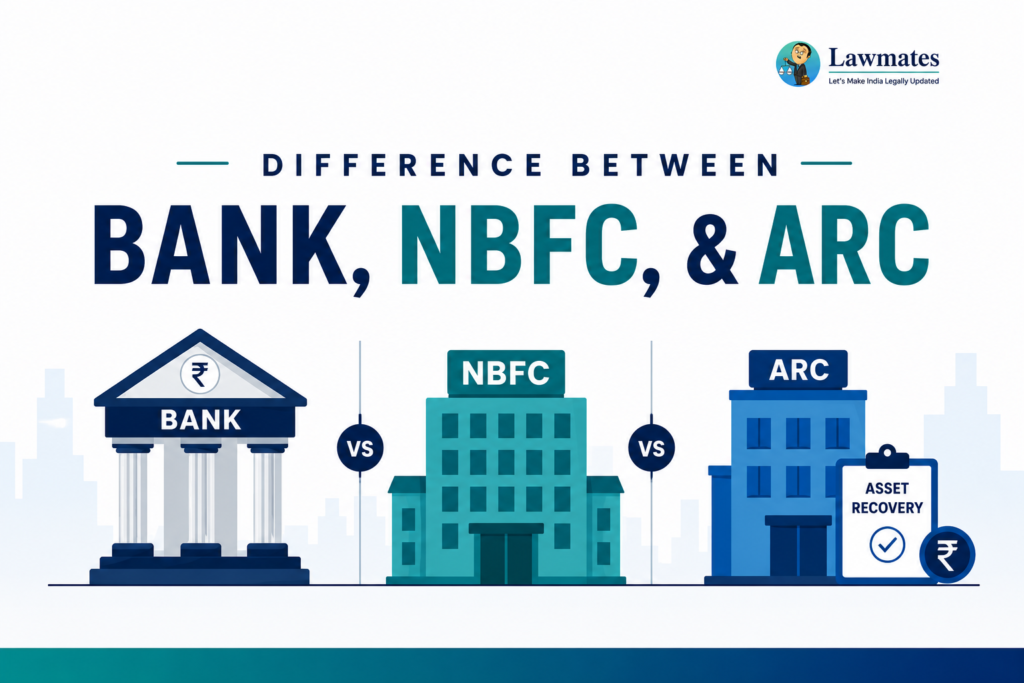
India’s financial system is built on several institutions that work together to maintain economic stability and provide financial assistance to individuals, businesses, and industries. Among the most important financial institutions are Banks, NBFCs (Non-Banking Financial Companies), and ARCs (Asset Reconstruction Companies). Although these terms are often used together in discussions related to Banking & Finance Law, many people remain confused about their meaning, functions, and differences. While all three institutions deal with money and financial activities, their roles, powers, and objectives are completely different. This article explains the meaning, functions, regulatory framework, and major differences between NBFCs, Banks, and ARCs in a simple and easy-to-understand manner. What is a Bank? A Bank is a financial institution authorized by law to accept deposits from the public and provide various banking and financial services. Banks form the backbone of the economy because they manage public money, facilitate transactions, and support economic growth through lending activities. Banks operate under strict regulations issued by the Reserve Bank of India (RBI) and are governed mainly by the Banking Regulation Act, 1949. The primary function of banks is to accept money from the public in the form of savings accounts, current accounts, and fixed deposits, and then use those funds to provide loans and credit facilities to individuals and businesses. Banks are considered one of the most trusted financial institutions because they offer secure deposit facilities and provide customers with easy access to their money. Main Functions of Banks Banks perform several important functions in the economy, including: 1. Accepting Deposits – Banks accept deposits from the public through: • Savings accounts • Current accounts • Fixed deposits • Recurring deposits 2. Providing Loans – Banks provide different types of loans such as: • Home loans • Personal loans • Vehicle loans • Education loans • Business loans 3. Payment and Settlement Services – Banks facilitate various types of Payment/Settlement services • Online transactions • UPI payments • Cheque clearing • NEFT/RTGS transfers • Debit and credit card services 4. Foreign Exchange Services – Many banks also provide foreign exchange and international banking services. What is an NBFC? NBFC stands for Non-Banking Financial Company. An NBFC is a financial institution that provides financial services similar to banks but does not possess a full banking license. NBFCs are regulated by the Reserve Bank of India under the RBI Act, 1934. Although NBFCs provide loans and financial assistance, they generally cannot accept demand deposits like savings or current account deposits from the public. NBFCs play a major role in India’s financial system by serving customers and sectors that may not always receive adequate financial support from traditional banks. They are especially important in rural financing, vehicle financing, infrastructure funding, and small business lending. In recent years, NBFCs have gained popularity because of quicker loan approvals, flexible documentation, and easier access to credit. Main Functions of NBFCs 1. Providing Loans and Advances – NBFCs also provides certain loans like banks but their policies are different and they cater wider audience than banks. Some of the loans NBFC’s offers are: • Personal loans • Business loans • Vehicle loans • Gold loans • Consumer finance 2. Asset Financing – Many NBFCs specialize in financing vehicles, machinery, and equipment. Many NBFCs play a major role in financing assets such as vehicles, machinery, and industrial equipment, especially in sectors where traditional banks may hesitate to lend quickly or flexibly. NBFCs are widely known for providing: • Car loans • Commercial vehicle loans • Two-wheeler financing • Truck and logistics financing They often cater to: • Small business owners • Drivers and transport operators • First-time borrowers with limited credit history Unlike banks, NBFCs generally offer: • Faster approvals • Flexible repayment options • Easier documentation This makes them highly popular in India’s transport and automobile sector. 3. Investment Services – Many NBFCs also engage in investment activities, wealth management, and portfolio management as part of their broader financial services business. In terms of investment activities, NBFCs invest in financial instruments such as shares, bonds, mutual funds, government securities, and corporate debt to generate returns and diversify their sources of income. Several NBFCs also provide wealth management services, helping individuals and businesses manage their finances through investment planning, retirement planning, tax-efficient strategies, and financial advisory services. In addition, some NBFCs offer portfolio management services where financial experts professionally manage clients’ investments across multiple asset classes such as equities, debt instruments, and mutual funds with the objective of maximising returns while balancing financial risks. These services have made NBFCs an important part of India’s evolving financial ecosystem beyond traditional lending activities. 4. Leasing and Hire Purchase – Certain NBFCs also offer leasing and hire purchase facilities to both businesses and individuals, providing an alternative method of acquiring assets without making full upfront payments. Under a leasing arrangement, the NBFC purchases an asset such as machinery, vehicles, industrial equipment, or office infrastructure and allows the customer to use it for a fixed period in exchange for regular rental payments. Ownership of the asset generally remains with the NBFC during the lease term. This model is especially beneficial for businesses that want to reduce initial capital expenditure while still accessing essential equipment for operations and expansion. In a hire purchase arrangement, the customer acquires the asset by paying in instalments over a specified period while using the asset from the beginning itself. Once all instalments are paid, ownership of the asset is transferred to the customer. Hire purchase facilities are commonly used for purchasing commercial vehicles, machinery, consumer durables, and business equipment. These financing models help businesses maintain cash flow, improve operational flexibility, and expand without immediate large financial commitments, making NBFCs an important source of asset financing in India. 5. Financial Inclusion – NBFCs help provide financial services in areas where traditional banking facilities may be limited. Restrictions on NBFCs Despite offering a wide range of financial services, NBFCs operate with certain regulatory limitations when compared to banks. They are not permitted to issue
From Coin Collector To Luxury Disruptor: How Jaipur Watch Company Is Building India’s Next ₹100 Cr Icon

Summary: Jaipur Watch Company was founded by Gaurav Mehta to bring Indian heritage to the world of luxury watchmaking through design-led, culturally rooted timepieces. By combining global precision with Indian craftsmanship, the brand has successfully overcome early challenges around consumer trust and manufacturing capabilities. With strong revenue growth, expanding retail presence, and international ambitions, Jaipur Watch Company is steadily building what could become one of India’s most enduring luxury brands. Prime Minister Narendra Modi’s sartorial choices often spark conversation, whether it is his signature kurtas, elegant jackets, or distinctive accessories. Recently, it was a wristwatch that caught public attention. During an appearance on April 10, the Prime Minister was seen wearing a striking timepiece featuring a tiger motif. Watch enthusiasts were quick to identify its origin: Jaipur Watch Company (JWC), an Indian luxury watchmaker known for blending heritage with horology. The moment was more than a style statement. It highlighted the growing appeal of an Indian brand that is redefining luxury watchmaking through craftsmanship, storytelling, and cultural pride. Building an Indian Legacy in Luxury Watchmaking Founded in 2013 by Gaurav Mehta, Jaipur Watch Company was born out of a simple but ambitious idea: to create an Indian watch brand that could stand alongside global luxury names while remaining deeply rooted in Indian heritage. Mehta, a lifelong collector of old coins, found inspiration in the stories they carried. His fascination with history, combined with a passion for horology, led to the creation of a brand that transforms heritage into wearable art. Unlike conventional luxury watches, JWC offers more than just precision engineering. Each piece carries a narrative. Whether it features a rare coin, a vintage stamp, or hand-painted miniature art, every watch is designed to create an emotional connection with its wearer. Crafting Timepieces That Tell Stories Jaipur Watch Company has built its reputation on distinctive collections that celebrate India’s cultural and historical legacy. Its flagship offerings include the Baagh Collection, inspired by the iconic 1947 one-rupee coin bearing a tiger, and the Eternal Watch Collection, crafted from the first coins minted in independent India. The Pichwai Art Collection showcases hand-painted dials created by skilled Rajasthani artists, while the Imperial IV Automatic incorporates a King George VI half-rupee silver coin from the pre-independence era. These collections have helped JWC carve out a unique niche in the premium watch segment. With an average order value of around ₹45,000, the brand occupies a sweet spot between mass-premium fashion watches and ultra-luxury global watchmakers. Overcoming the Challenges of Building a Luxury Brand in India Creating a luxury watch brand in India was never going to be easy. One of the earliest challenges was consumer perception. For decades, luxury watches have been associated with Switzerland and other established global markets. Convincing customers to place an Indian brand in the same aspirational category required patience, consistency, and trust. The second hurdle was infrastructure. India lacked a mature ecosystem for precision watchmaking. Suppliers capable of meeting luxury-grade standards in finishing, consistency, and tolerances were limited. Over time, Mehta worked closely with vendors to raise quality benchmarks and build a more reliable supply chain. Today, JWC follows a hybrid production model. While it sources precision movements from established international manufacturers, the design, case development, dial craftsmanship, and product storytelling are all driven from India. This balance allows the company to maintain global quality standards while preserving its distinctly Indian identity. A Growing Market and Ambitious Expansion Plans India’s luxury watch market, currently valued at approximately $600 million, continues to grow steadily. Rising disposable incomes, increasing numbers of high-net-worth individuals, and a younger generation seeking statement accessories have all contributed to this expansion. Jaipur Watch Company has successfully broadened its customer base beyond collectors and bespoke buyers. Today, its clientele includes entrepreneurs, professionals, legacy-minded families, and young consumers looking for meaningful luxury. For FY26, the company is on track to achieve revenue of ₹40 crore. This growth is being driven by a strong omnichannel strategy, improved inventory efficiency, and an expanding retail footprint. JWC currently operates 14 outlets across India, with plans to open five more in the near term. By the end of FY27, the company aims to have 25 stores nationwide. The brand is also preparing to open its first standalone international store, marking a significant step in its global expansion journey. The Road to ₹100 Crore and Beyond Jaipur Watch Company is not merely chasing short-term growth. Its ambition is to build an enduring luxury house. Mehta has set a target of reaching ₹100 crore in revenue within the next three years, but his vision extends far beyond financial milestones. The company remains open to strategic partnerships and capital infusion that can support international distribution, operational scale, and institutional growth. At the same time, it is investing heavily in strengthening its supply chain and elevating the retail experience. What truly sets JWC apart is its commitment to authenticity. Every collection reflects a thoughtful balance of design, heritage, and craftsmanship. Rather than imitating global templates, the brand is creating its own identity—one rooted in India’s rich cultural legacy. Conclusion Jaipur Watch Company represents a new chapter in Indian luxury. It is proving that world-class watchmaking need not be confined to traditional global hubs. By combining heritage, innovation, and meticulous craftsmanship, JWC has positioned itself as a pioneer in India’s emerging luxury watch landscape. Its journey from a niche concept to a nationally recognised premium brand reflects not just entrepreneurial vision, but also a growing confidence in Indian luxury. If its current trajectory continues, Jaipur Watch Company may well become the first truly iconic Indian name in global horology.
How Bonkers Corner Didn’t Just Build a ₹195 Brand — It Outsmarted India’s D2C Playbook

Summary Bonkers Corner began in 2020 with founder Shubham Gupta doing the basics right — creating simple designs, testing them as mockups, and using Instagram ads to generate real demand before even producing inventory. What followed wasn’t aggressive expansion, but disciplined execution. The brand stayed consistent with its core playbook: focus on everyday essentials, keep the team lean, and maintain complete control by running operations in-house. Today, Bonkers has scaled that simple approach into a massive unisex streetwear portfolio of over 12,000 SKUs, spanning oversized apparel, gym wear, joggers, hoodies, and sweatshirts — proving that clarity beats complexity in building a fashion brand. The Anti-Startup Story Nobody Talks About In India’s startup ecosystem, there’s a predictable script:Raise funding → burn cash → chase growth → worry about profits later. Bonkers Corner did the exact opposite. No funding. No hype. No big launch. Just Instagram, instincts, and an understanding of what Gen Z actually wanted to wear. And somehow, that was enough to build a ₹195 crore brand. It Didn’t Start As A Business — It Started As A Bet Back in 2020, when most people were figuring out lockdown survival, Shubham Gupta was testing T-shirt designs on Instagram. No warehouse.No inventory.No guarantee anyone would buy. Here’s the interesting part — he didn’t even start with products. He started with mockups. Run ads → get orders → then produce. This isn’t just smart. It’s brutally efficient. Opinion:Most D2C founders in India overestimate demand and overinvest early.Bonkers did the opposite — it earned the right to scale. While startups were busy raising rounds, Bonkers was doing something unpopular:Making money. Every rupee spent had to justify itself. Opinion:Bootstrapping forces discipline. Funding often hides inefficiency. Bonkers didn’t just survive without funding — it became stronger because of it. Owning Manufacturing = Owning The Game Most D2C brands in India:👉 Outsource everything Bonkers:👉 Built in-house manufacturing That changes everything: Opinion:This is the real moat. Anyone can run ads.Anyone can hire influencers. But not everyone can control production at scale. Influencer Marketing — But Not The Dumb Version Yes, Bonkers used influencers heavily. But here’s the difference:It wasn’t vanity marketing. It was performance-driven. Early on, they spent nearly half their budget on influencers — not for “branding”, but for conversion. Opinion:Most brands treat influencers like billboards.Bonkers treated them like a sales channel. That mindset shift is everything. Offline Stores: The Unexpected Growth Engine In 2023, Bonkers went offline. At first glance, it sounds counterintuitive. Why would a digital-first brand go physical? Because:👉 People still want to touch fashion. Now: Opinion:The future isn’t online vs offline.It’s integration. Bonkers understood this earlier than most D2C players. Funding Came Late — Exactly When It Should Bonkers didn’t raise money to survive. It raised money to scale. That’s a huge difference. By the time funding came: Opinion:This is how funding is supposed to work. Not as oxygen. But as fuel. So What’s The Real Lesson Here? Bonkers Corner isn’t just a success story. It’s a quiet critique of how most startups operate. What it got right: