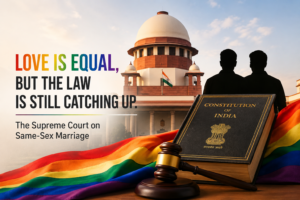
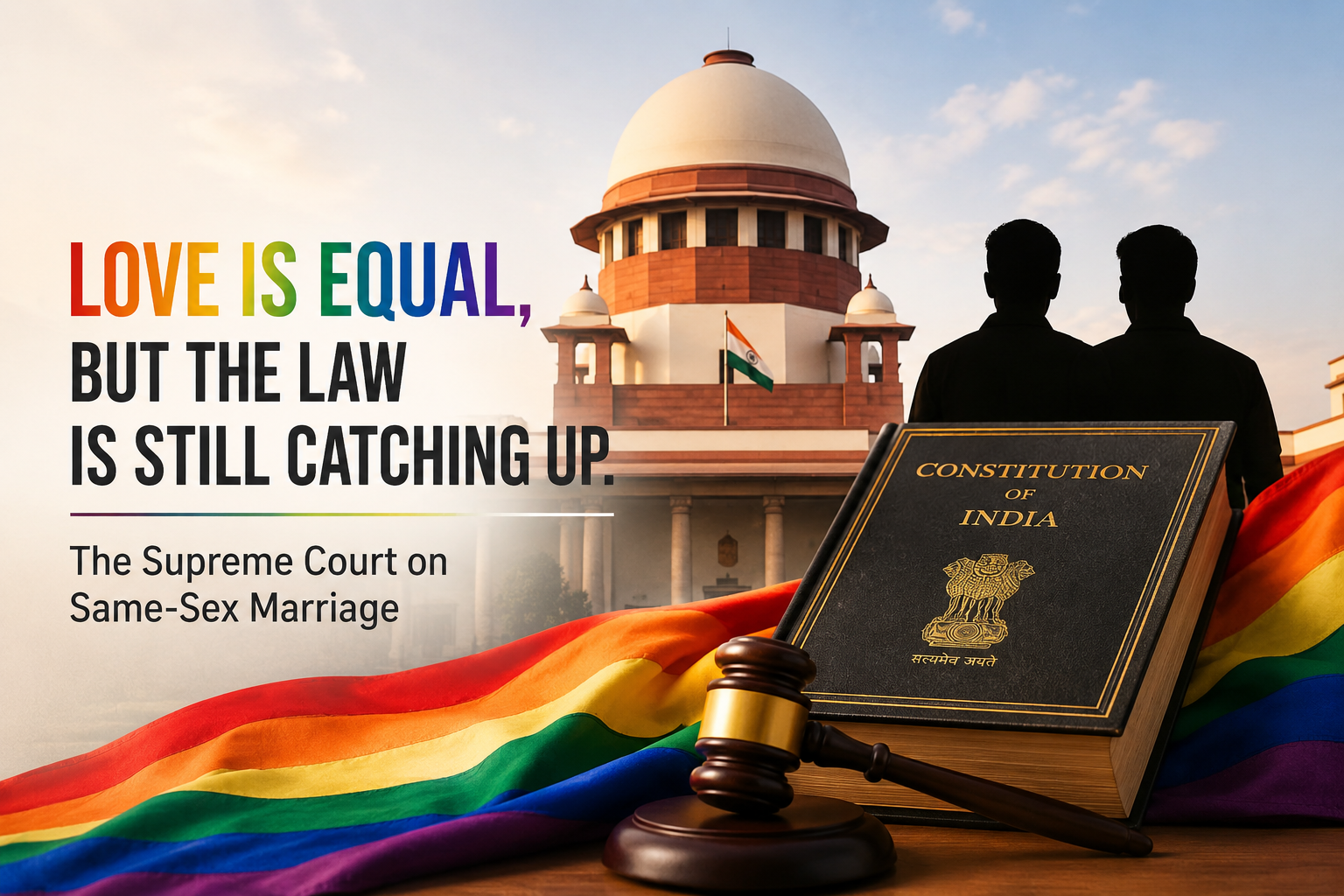
| In October 2023, five judges of the Supreme Court of India sat across a question that had been building for years, both inside courtrooms and outside them: Can the law recognise the right of same sex couples to marry? The answer, delivered in a split but decisive ruling in Supriyo v. Union of India, It was not what many had hoped for. The Court declined to legalise same sex marriage. And yet, to read the judgment merely as a “no” would be to miss its deeper, more complicated legacy. |
A Case About Marriage – That Became About Citizenship (Supriyo v. Union of India)
The petitions before the Court were, on paper, straightforward. Couples from the LGBTQ+ community sought recognition of their relationships under existing laws like the Special Marriage Act. They argued that exclusion from marriage was not just symbolic, it denied them tangible rights:
- inheritance and succession
- adoption and parenthood
- medical consent and next-of-kin status
- social legitimacy
But as arguments unfolded, the case expanded into something larger: What does equality mean in a constitutional democracy? And more pointedly, who gets to define the boundaries of a family?
The Court Draws a Constitutional Line
The Constitution, the bench agreed, protects dignity, autonomy and the right to form relationships. In fact, this position had already been laid down in earlier rulings like the decriminalisation of homosexuality.
Yet, when it came to marriage, the Court stopped short.
The majority held that:
- There is no fundamental right to marry recognised under the Constitution in the manner claimed
- Courts cannot rewrite statutory frameworks like the Special Marriage Act
- Expanding marriage to include same sex couples would require legislative action, not judicial intervention
In essence, the judges acknowledged the legitimacy of queer relationships, but refused to extend to them the institution of marriage.
It was a careful distinction and also a controversial one.
Recognition Without Full Rights
Where the judgment becomes more nuanced is in what it did recognise.
The Court affirmed that:
- Queer couples have the right to cohabit and form families
- The State has an obligation to protect such relationships from discrimination
- Administrative authorities must ensure that queer individuals are not denied basic entitlements
There was also a direction to the government to consider forming a committee to examine the rights and benefits that could be extended to same sex couples.
But crucially, on issues like adoption rights, the bench was divided, and the final outcome offered little immediate change.
A Bench That Spoke in Different Voices
What made the judgment particularly striking was its internal disagreement. While the majority leaned toward judicial restraint, minority opinions were more expansive. They argued that constitutional morality must evolve with society and that denying marriage rights perpetuates structural inequality.
This divergence did not alter the final outcome — but it revealed a judiciary grappling with the limits of its own power.
Why the Court Stepped Back
To understand the ruling, one must look beyond rights discourse and into institutional boundaries.
The Court appeared cautious about:
- Rewriting an entire legislative framework that governs marriage across religions and communities
- Entering a domain with wide social and political consequences
- Setting a precedent where courts, rather than Parliament, reshape core social institutions
In doing so, the judgment reflects a broader philosophy: that not every progressive outcome can or should come from the judiciary.
The Real-World Impact: A Legal Vacuum
For same sex couples, the consequences remain immediate and tangible.
Without legal recognition of marriage:
- Partners cannot automatically inherit property
- They lack spousal benefits under employment and insurance laws
- Medical decision-making remains uncertain
- Adoption as a couple remains largely inaccessible
In effect, relationships may be socially visible, even constitutionally acknowledged, but remain legally incomplete.
The Conversation Moves Beyond the Courtroom
If the judgment closed one door, it opened several others.
Since the ruling:
- Policy discussions around civil unions and partnership rights have gained momentum
- Activists and legal scholars continue to push for incremental recognition through legislation
- Public discourse has become more mainstream, moving beyond legal circles into everyday conversation
The Court, in a way, shifted the responsibility from judges to lawmakers, from courtrooms to Parliament.
A Judgment That Will Age With Society
History suggests that transformative rights often arrive in stages. What appears as judicial hesitation today may, in time, be seen as part of a longer constitutional journey.
The same sex marriage verdict does not settle the issue. It merely defines the present boundary.
And boundaries, in a living Constitution, are rarely permanent.
Case Citation
Case: Supriyo v. Union of India
Court: Supreme Court of India
Date of Judgment: 17 October 2023
Case Type: Writ Petition (Civil) No. 1011 of 2022
Significance: A landmark moment not for what it granted, but for how it reframed the debate on equality, dignity, and the role of courts in social change.